 English
  Español
  Français
Vibratory finishing is now the most popular type of mass finishing process.
In some cases, people will think vibratory finishing equals mass finishing.
Another process uses centrifugal barrel machines, centrifugal disc finishing machines, and rotary barrel machines. Some unique procedures will be done in some special surface finishing machines.
The process of vibratory finishing is carried on in a vibratory bowl or a vibratory tub for parts surface deburring, polishing, smoothing, cleaning, descaling, rust removal, radiusing, etc.
The first vibratory finishing machine is tub-type, which was introduced in 1957.
Five years later, in 1962, the bowl-type vibratory finishing machine is invented and commercialized.
1. Major process in vibratory finishing:
1.1 Deburring
Deburring has the most comprehensive application in the vibratory finishing process.
Usually, people use a mild compound with a PH around 7.0 and a general performance ceramic media to deburr.
Mild steel stamping parts deburr with ceramic media in 30-60 min.
And aluminum dye casting parts to deburr with plastic media in 1-2 hours.

Deburring
In the deburring process, the compound cleans off machining oil or lubricant in the same time cycle.
This leaves a neat surface for assembling and handling.
1.2 Burnishing
The burnishing process is usually done with a steel ball and can be done with a zirconia ball.
Steel media, including ball shape and ball cone shape, are most popular.
When ball shape steel media can offer better polishing performance, ball cone shape steel media never remove burrs but hammer down the burrs and leave a dull edge.

Burnishing
Cleaning media before the process is critical to performance.
Dull media always results in dull metal finishing.
As a result, keep tumbling media shining and glossy is essential.
Compound selection is another essential factor to determine ball burnishing quality.
Several different burnishing compounds formulate according to other materials: stainless steel, aluminum, zinc, and copper.
The ball burnishing process is carried out usually in a curved wall vibratory finishing machine or tub vibratory machine.
In a curved wall design machine, tumbling media rotate in a cross-section area.
This achieves maximum surface contact between parts and media and acquires optimal tumbling performance.
The ball burnishing process time usually takes 20-30 minutes to get a brilliant surface.
1.3 Smoothing
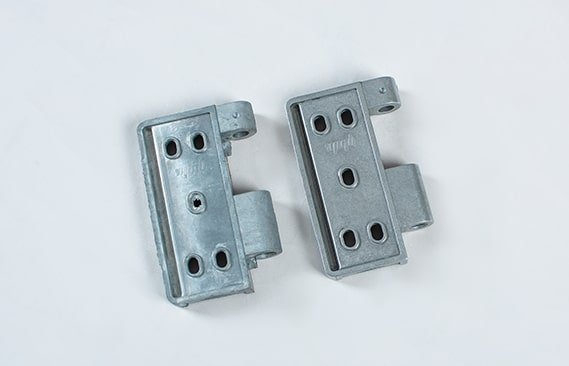
Parts surface properties change with different media processing.
Cutting marks from machining and wheel grinding process almost every components manufacturers come up with.
Ceramic media offer an economical way to give the metal surface a pre-painting finishing.
Smoothing
Select plastic media for soft metal materials like aluminum, copper, and zamak3 to get a superior pre-plating finish.
In some application, you can matt finish surface with ceramic media with increased surface roughness.
This property is required in the friction pad in the automotive industry.
1.4 Cleaning and degreasing
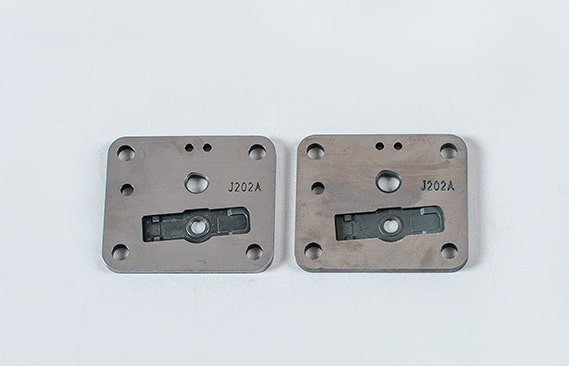
When cleaning oily and greasy parts, a vibratory finishing machine is the right choice.
In the cleaning process, we want to run it in a pass-through mode. So we save time and give more output.
Cleaning and degreasing
The larger the machine diameter, the longer the time parts stay in the machine, and the better the cleaning parts.
The best media for the cleaning is porcelain media and steel tumbling media because they have almost no clothing.
The media does not leave wear debris, which contaminates and leave on parts surface.
Besides, media will not reduce in size (which is costly for you) and risk lodging in parts.
However, the cleaning compound is the main contributor.
Compound type selection, dosing rate, and concentration are the key factors related to performance.
This process requires a strong acidic compound to clear off fatty and oily substances from the metal surface.
Even though the hot solution can reduce degreasing and cleaning time, we will use cold water.
A hot solution will soften PU lining and result in premature wear.
1.5 Rust Removal
parts process in high temperature (laser cutting/plasma cutting/welding) leave the surface’s oxidation layer.
However, the oxides and corrodes that adhere to the metal surface always result in paint chips and low plating quality.
As a result, the vibratory finishing process must remove the oxide layer and make the metal surface smooth before the next procedure.

Rust removal
The rust layer usually is thick.
Also, the corrosion surface sticks tightly on the metal base material.
Use ceramic media with strong cutting power to remove these materials.
In some cases, a strong cutting compound is used to reduce processing time.
Hydrochloric acid and sulfuric acid or their mixtures are used in some special applications for oxide removal.
1.6 Radiusing
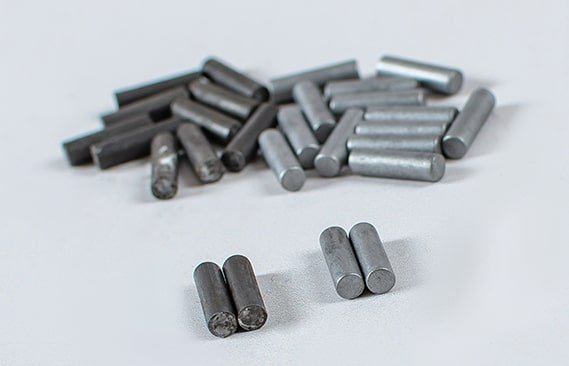
Radiusing is called edge rounding or edge breaking.
It is the process of making parts edge round and smooth.
The property is required for most metal components with direct contact with users.
Radiusing
The round edge can protect the user and operator from likely injuries.
Besides, it also makes it easier for laborers to handles and smoother parts on parts workflow.
In the vibratory finishing process, the edge rounding process usually comes together with deburring and surface material removal.
2. Key Element in Vibratory Finishing
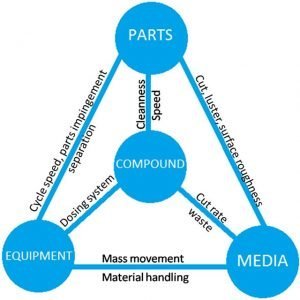
Parts media compound equipment interaction
2.1 Parts
The parts size decided the type of vibratory finishing machine that can be used.
Small parts like pins and tabs are usually made with colossal production volume every day.
You don’t want to pick 10,000 pieces of parts one by one out of the machine once they are ready.
As a result, the vibratory bowl finishing machine is preferred in the situation.

Various parts to finish from different industries
Larger parts like transmission gear parts would be faster to take out by hand.
If the parts’ size is more extensive, like the ceramic coated exhaust pipe, most vibratory bowl channels cannot accommodate.
Then you need to consider a vibratory tub.
2.2 Equipment
2.2.1 VB(A) Vibratory Finishing Machine:
The curved wall design vibratory finishing machine is popular for an excellent cascade of media and parts flow.
This makes shorter cycle time of the process and saves cost in the high polishing process.
One of the major applications for the curved wall vibratory machine is the ball burnishing process.
When burnishing with stainless steel tumbling media, vibrator motor power updated to support increase loading weight.
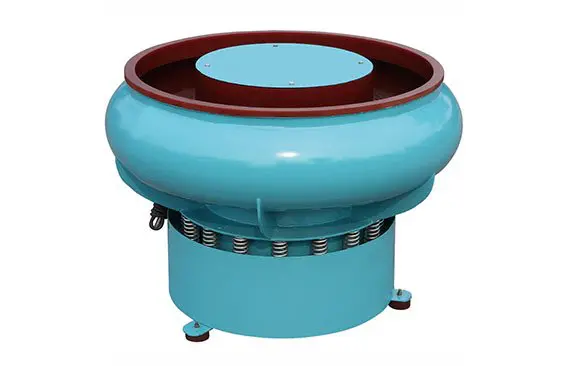
VB(A) vibratory finishing machine
Some small parts or lightweight parts (for example, aluminum die casting parts) tend to float at the outer surface with standard vibratory machines.
With the increased tumbling performance, these parts have excellent movement with media mass.
2.2.2 VB(B) Vibratory Finishing Machine:
The standard vibratory finishing machine without an internal separation deck is the simplest machine type.
If you have no special requirement on parts, you can use this economic model to get started.
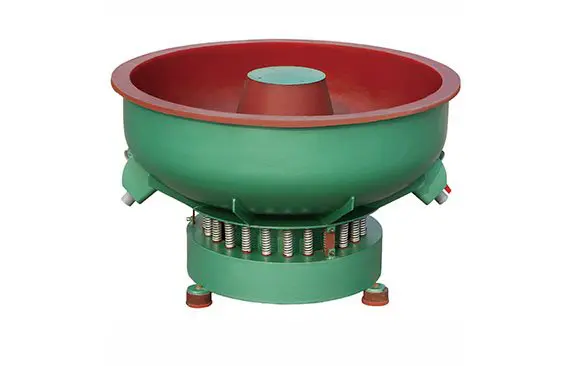
VB(B) vibratory finishing machine
Straight wall vibratory finishing machines widely suit for most medium size parts deburring and cleaning.
2.2.3 VBS(B) Vibratory Finishing Machine:
When you process hundreds or even thousands of parts each load, taking out parts piece by piece with the hand is time-consuming.
Then you need a vibratory machine with a separation deck integrated into the machine.
When parts are ready, the lever at the right side of the machine is pulled down, then the mass moves onto the separation screen.

VBS(B) vibratory finishing machine
Media with a smaller size go through the screen, and parts with a larger size keep up over the screen.
After the final parts come out, you can close the level shutter and continue with the next batch processing.
2.2.4 VBS(A) Vibratory Finishing Machines:
Curved wall design vibratory finishing machines are an excellent improvement based on straight wall design.
They offer better tumbling performance with a shorter processing time.

VBS(A) vibratory finishing machine
However, the machine chamber width is narrower than with the straight wall design.
More significant components are not easy to make a complete turnover.
Besides, fewer media and parts mass can be put in the machine.
2.2.5 Vibratory Dryer:
Vibratory dryers have mostly the same design as vibratory finishing machines.
Practically there are two types of vibratory dryers: one with PU lining and another without.
The one without PU design is most popular among workshops for simple design and maintenance-free.
There are 6 sets of heating elements installed beneath the vibratory bowl.
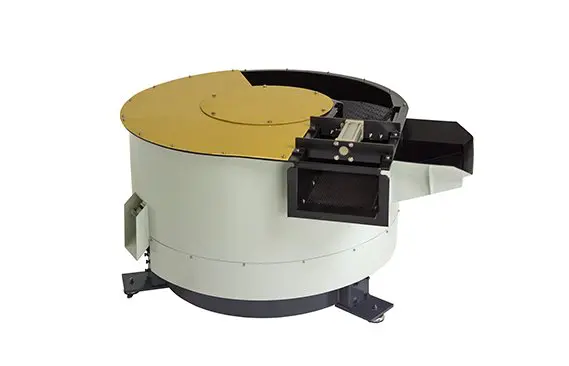
VD vibratory dryer
Usually, parts that come out of the vibratory finishing machine fall straightway into the vibratory dryer.
Then parts run one circle in vibratory dryer tunnel and come out.
Because corn cob is a lightweight material, especially for the small size and grounded corn cob.
A PVC cover is necessary to prevent corn cob dust from flying.
However, if parts have blind holes, vibratory dryers not recommend.
Because corn cob stuck into parts slots or holes is hard to take it out.
2.3 Tumbling Media
2.3.1 Media type
For general deburring of a hard metal material, ceramic media with brown aluminum oxide abrasive (corundum) is frequently used.
An experienced engineer selects case hardened stainless steel tumbling media for the ball burnishing process.
Plastic media usually choose for aluminum and zinc die casting parts smoothing and deburring.
2.3.2 Media shape and size
After selecting the right media type, the next step is to choose the correct media size and shape.
Right media size and shape are essential to prevent parts from lodging and easy for separation.
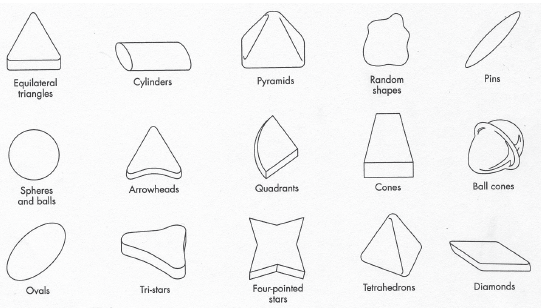
Different media shape for mass finishing
First, we choose the shape of media, the media shape not easy to lodge on parts even after a long time of running. Secondly, we select the size of the media.
Media size should be significantly smaller than parts.
As a result, vibratory finishing machines can easily make a separation on the screen.
If parts are much smaller than media, then you can make the inverse separation.
Compared with small size media, big size media is cheaper, longer life, and cut faster.
However, big-size media leave the rougher surface compared with small media.
So you can choose the more prominent media that does not affect your surface quality.
2.3.3 Media to parts ratio
The final step is to decide the media to parts mixture ratio.
To maximize your output, you always want to put extra pieces in your vibratory bowl.
However, too many parts in a vibratory bowl result in parts on parts impingement. So here we make some idea regarding media to parts ratio:
1:1 Media and parts are mixed in equal capacity.
The small amount of media will make parts on parts hit and scratch a lot.
This can work out when the surface mark is not a problem.
3:1 The average ratio use in the vibratory finishing process.
However, with a vibratory finishing machine with internal separation, you need to have a higher ratio of 4:1.
8:1 8 times and higher media to parts ratio suggest for delicate parts.
This mixing ratio is also used in the vibratory polishing and burnishing process.

Parts to media volumetric ratio
2.4 Compound and Water
The correct choice of the compound is critical to get optimal finishing results.
Use the most grinding compound.
Formulate compounds in liquid form.
3. A step by step guide for the vibratory finishing process
3.1 Check your parts and decide machine volume
Make the estimation of how many parts you need to run every day, how much time to finish them, the parts to media ratio.
You will know the right size and model of a vibratory finishing machine for your job with the information above.

For example:
You have 2000 pieces of the zamak3 belt buckle to deliver to your customer every day.
Each day you have 10 working hours in your workshop.
From sample testing, you know the vibratory smoothing process takes 1.5 hours with plastic media.
It will take 30 minutes for parts loading and unloading.
Now we can calculate we need a machine that can hold up to 400 zamak3 buckles a day.
To prevent parts scratch and hit, media to parts volume ratio is 3:1
After that, you measure 400 pieces belt buck stacking volume as 50L
The real volume for the machine is 200L
However, in vibratory finishing machines, we only use about 70% of the total capacity.
This means total machine capacity 200÷70%=285L
You know you need a 300L (or 10 cubic feet) vibratory finishing machine.
3.2 Find a suitable but not expensive machine
The most costly machines not always the best choice.
Keep the machine as simple as possible.
The more complicated the machine, the more likely it will go malfunction somewhere, especially for the electronic device.
We don’t install an automatic oil lubrication system in the vibratory motor.
This adds to the cost and complexity of the machine.
We would instead prefer a manual gun which lubricates once a month with 2-3 strokes.
If you can do with vibratory finishing machines without internal separation, then buy a machine without it.
The machine installation is vital before you start to use the machine.
Vibratory finishing machines structure is simple and ready to go.
If you have experience for the job, you can do it by following our vibratory finishing machine installation guide.
If you are a first time user of vibratory finishing machines, better to find an electrician close to your location.
3.3 Make installation and get it run
If you can choose electricity, go with 3 phase electricity, for example, 380V, 460 V or 480 V.
A single-phase voltage 220V will significantly increase your amperage flow.
Besides, ground 3 phase electricity is safer.
After confirming compound performance, you also need to look at compound concentration because it is essential for your operational cost.
A compound with a high concentration and the mixing ratio will save you lots of money; even their price is higher with the same package.
If you can buy a compound in tons, the compound’s cost will be significantly reduced and freight reduced as well.
However, if the machine does not work in the right condition, just call the man your machine purchase.
You can call your media supplier, your compound supplier.
Life is short, so we do everything right in a simple way.