
 English
  Español
  Français


Economic Centrifugal Spin Dryer
- Description
- Feature
- Application
Before machine starting using, please check the power connection. If power connected, then close the cover and turn on the machine swift. Check if the machine has hot air come out of the machine. If the machine is not hot after 5 minutes’ running, then check if the heating element is in the proper condition.
When machine operating, parts should be evenly spread in the barrel. You can firstly run the machine without heating for 1-2 minutes to remove most of the water then make the drying.
When the process finished, first close the power then you can use the brake. This machine can use centrifugal spinner only. But you can not use heating function only without spinning function.
| Model | SK35A | SK70A |
| Barrel Size | φ400x300mm | φ500x400mm |
| Weight capacity | 35kg | 70kg |
| Rotation speed | 630 rpm | 530 rpm |
| Voltage | 380V 50HZ 3phase | 380V 50HZ 3phase |
| Motor power | 0.75kw | 1.1kw |
| Heating power | 3kw | 3kw |
- Low cost
- Easy to operate
- Small footprint and compact design
- Light device
- Easy to maintenance
- Small and medium parts drying
- Small and media size parts de-oiling
Related Products
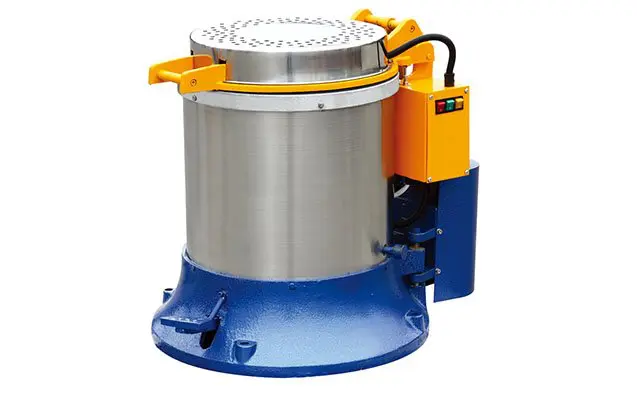


Economic Centrifugal Spin Dryer
Economic Centrifugal Spin Dryer — fast, affordable part drying and de-oiling for electroplating workshops and mass finishing operations
The economic centrifugal spin dryer removes surface water from small and medium metal parts using centrifugal force combined with low-temperature heating. Parts are loaded into the rotating barrel; spinning at 530–630 rpm throws water outward while the 3 kW heating element warms the barrel interior to accelerate evaporation. The result is dry parts ready for plating, coating or packaging in a fraction of the time that air drying or towelling would take, at a fraction of the cost of a full-scale vibratory dryer.
Two models — the SK35A (35 kg capacity) and SK70A (70 kg capacity) — cover the range from small workshop to medium-production environments. Both run on 380V/50Hz/3-phase supply and share the same compact, portable design. The primary market is electroplating workshops where wet parts arrive directly from the plating tank and need to be dried quickly without streaking or water spot formation before inspection and packaging.
- Centrifugal spin + heating — removes water faster than air drying without water spotting
- Low cost — entry-level price point for workshops that don’t need a full vibratory dryer
- Compact and light — small footprint, easy to move and position
- Simple operation — spin first to remove bulk water, then add heat to complete drying
- Two capacities — SK35A (35 kg) and SK70A (70 kg)
- Also used for de-oiling — spin removes surface oil from parts after machining or lubrication
At a glance
| Models | SK35A (35 kg) / SK70A (70 kg) |
| Drying method | Centrifugal spin + heating element |
| Power supply | 380V / 50Hz / 3-phase |
| Heating power | 3 kW (both models) |
| Primary application | Small and medium parts drying; de-oiling |
| Key market | Electroplating workshops; mass finishing operations |
How the centrifugal spin dryer works
Parts are spread evenly in the barrel and the lid closed. The machine spins at 530–630 rpm; centrifugal force throws surface water outward and out of the barrel. After 1–2 minutes of spinning, most free water is removed. The heating element is then activated to evaporate residual moisture. When drying is complete, the power is turned off and the brake applied to stop the barrel safely before opening.
| Step | What happens |
|---|---|
| 1. Load | Parts spread evenly in the barrel; lid closed |
| 2. Spin (no heat) | Run at 530–630 rpm for 1–2 minutes; centrifugal force removes bulk water |
| 3. Heat + spin | Heating element activated; residual moisture evaporated while spinning continues |
| 4. Stop | Power off, brake applied, barrel stopped before lid opened |
| 5. Unload | Dry parts removed for inspection, packaging or next process step |
Who the centrifugal spin dryer is built for
Electroplating workshops drying parts after the plating tank — this is the primary application. Parts coming out of electroplating are wet with plating solution; if not dried quickly and cleanly, water spots and staining form on the plated surface before it can be inspected and packaged. The centrifugal spin removes bulk liquid fast; the heating element completes drying without the streaking that towel-drying causes.
Small and medium mass finishing operations needing an affordable dryer — the SK35A and SK70A are the entry-level drying option in the Inovatec range. For workshops running a single vibratory finishing machine with moderate batch sizes, these provide effective post-finishing drying at a significantly lower cost than a VD200A or VD600A vibratory dryer.
Machining workshops removing surface oil from parts — the de-oiling application spins cutting fluid and lubricant off machined parts before inspection, storage or downstream processing. The centrifugal action is effective for removing surface oil without solvents.
Centrifugal spin dryer vs vibratory dryer — which to choose?
| Centrifugal Spin Dryer | Vibratory Dryer (VD series) | |
|---|---|---|
| Drying method | Centrifugal spin + heating | Heated corn cob media (vibratory) |
| Compound residue removal | Limited | ✓ Corn cob removes compound film |
| Polishing effect | None | Light polishing from corn cob contact |
| Cost | Lower | Higher |
| Footprint | Very compact | Larger |
| De-oiling | ✓ Yes | Not primary function |
| Best for | Electroplating, small/medium batches, de-oiling | Post-vibratory finishing, compound removal, high volume |
Model specifications
| Specification | SK35A | SK70A |
|---|---|---|
| Barrel size | Φ400 × 300 mm | Φ500 × 400 mm |
| Weight capacity | 35 kg | 70 kg |
| Rotation speed | 630 rpm | 530 rpm |
| Voltage | 380V / 50Hz / 3-phase | 380V / 50Hz / 3-phase |
| Motor power | 0.75 kW | 1.1 kW |
| Heating power | 3 kW | 3 kW |
Specifications subject to change without notice. Note: spinning and heating are combined functions — the heating element cannot be used without spinning.
Why Inovatec — a finishing partner, not just a machine seller
| Low cost Entry-level drying solution Effective drying at a fraction of the cost of a vibratory dryer. | 24h Reply on inquiries Technical questions answered fast so your buying decision isn’t stuck waiting. | Compact Minimal footprint Fits into tight electroplating or finishing workshop spaces without dedicated infrastructure. |
| 60+ Countries served Export packing and documentation handled as standard. | Full Auxiliary equipment range Centrifugal dryer, vibratory dryer, separator, magnetic separator — complete your line. | 15+ Years in finishing equipment Trusted by Bosch, Swatch, Toyota and 1,000+ customers worldwide. |
Download the specification sheet
↓ Download Centrifugal Spin Dryer Spec Sheet (PDF)
| Need help choosing the right dryer for your process? Tell us your part type, batch size and current drying challenge. We reply within 24 hours with a recommendation. |