 English
  Español
  Français
One of the most popular questions of surface finishing is how to calculate the tumbling machine capacity.
When selecting mass finishing equipment—particularly barrel tumbling machines and vibratory finishing machines—one of the most common questions is how to determine the appropriate machine capacity for a given production requirement.
Understanding Machine Capacity
Machine capacity refers to the effective working volume of a finishing machine under real operating conditions. While manufacturers often specify the total internal volume of a machine, the real usable capacity is constrained by the need to allow space for parts and media to move freely without interference.
Accurately estimating this capacity is crucial for ensuring efficient processing, avoiding overloading, and optimizing throughput in your production facility.
1. Calculating Vibratory Finishing Machine Capacity
The processing chamber of a vibratory finishing machine is shaped like a toroid. To estimate its internal volume:
Volume = ¼π2(R + r)(R – r)2
R = Radius of the bowl
r = Radius of the central hub section
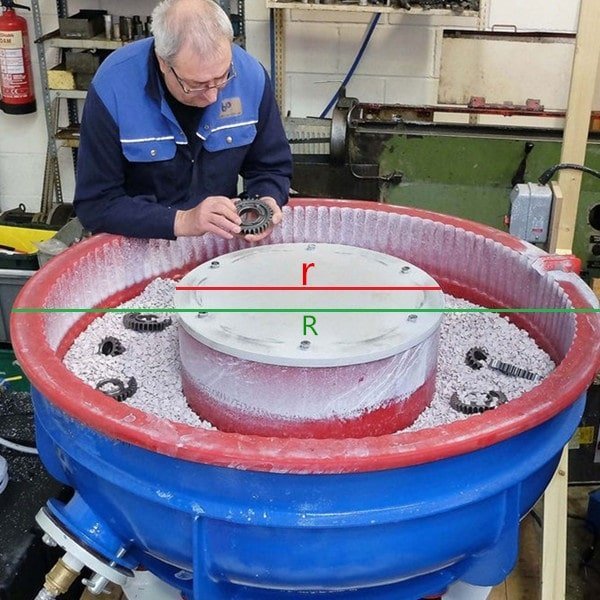
Vibratory finishing machine capacity-min
This formula provides a theoretical volume of the chamber. In practice, the effective capacity is approximately 80–90% of this figure to allow sufficient free space for media and parts to interact without causing damage.
2. Calculating Barrel Tumbling Machine Capacity
For barrel tumbling equipment, the internal volume can be calculated using:
Volume = ¼π2RL
R = Radius of the barrel’s cross-sectional diameter
L = Length of the barrel
However, because tumbling machines rely on rotational motion and require clearance for effective media movement, the practical capacity is typically around 50–60% of the theoretical volume.
3. Matching Capacity with Production Requirements
Once you know how to calculate machine volume, the next step is aligning capacity with your production conditions and the parts being processed:
Media-to-Parts Ratio
Selecting the appropriate ratio of media to parts is essential:
| Media to parts ratio (by volume) | Normal Commercial Application |
|---|---|
| 0:1 | No media, parts-on-parts. Used for beating off burrs. No media for cutting. |
| 1:1 | Equal volumes of media and parts. Forgings and castings; to produce crude, very rough surfaces. |
| 2:1 | More gentle, more separation, but still allows relatively severe part-on-part damage. |
| 3:1 | About minimum for non-ferrous parts. Considerable part-on-part contact. Fair to good for ferrous metals. |
| 4:1 | Probably average for non-ferrous parts. Good for ferrous metals. |
| 5:1 | Good for non-ferrous metals. Minimal part-to-part contact. |
| 6:1 | Very good for non-ferrous parts. Common for preplate on zinc with plastic media. |
| 8:1 | For higher quality preplate finishes. |
| 10:1 to 20:1 | Even better. Used for very irregular shaped, fragile parts. |
| infinite | Absolutely no part-to-part contact. One part per machine or compartment, or the part is fixed. |
Part Dimensions and Geometry
Understanding the volumetric displacement of parts helps determine how many pieces can be processed:
Part dimensions (length, width, height) can be used to calculate volumetric requirements.
The number of parts per liter can then be estimated and used to set load guidelines.
4. Machines and Production Planning
When machine capacity is properly understood and matched to production needs:
Operators can select the most appropriate machine size.
Processing cycles can be optimized to meet daily output goals.
Production quality and workflow efficiency are improved.
For example, if a workshop processes a large number of parts daily, knowing both cycle time and handling time enables precise calculation of required machine volume and loading strategies.
5. Case Study: Capacity Estimation in Practice
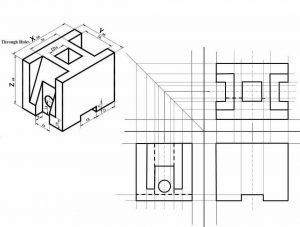 Orthographic Projection
| Factor | Value |
|---|---|
| Daily working hours | 8 hours |
| Parts to finish | 3,000 |
| Per cycle process time | 2 hours |
| Handling time | 30 minutes |
| Part size | 20 × 10 × 4 mm |
| Part material | Steel |
| Fragile? | No |
| Required media:part ratio | 3:1 |
Step-by-Step Calculation:
Part volume = 20 × 10 × 4 = 800 mm³
Volume for 1000 parts (1 shift) = 1000 × 800 = 800,000 mm³ = 800 liters
Media + Parts total = 800 × (1 + 3) = 3200 liters total capacity needed
Per shift capacity = 3200 ÷ 3 = ~1100 liters
Recommended machine size = 1200-liter vibratory finishing machine
✅ Alternative Options:
Use 2× 600L machines to increase flexibility and reduce downtime.
Or extend working hours to 16 hours/day, then 1× 600L machine is sufficient.
6. Conclusion
Accurate estimation of finishing machine capacity involves:
Calculating usable machine volume based on geometric formulas.
Understanding the real capacity limits considering media movement and part interaction.
Aligning capacity with part size, media-to-parts ratio, and production goals.
This approach ensures that equipment selected will support efficient operations and consistent surface finishing performance.