
 Français
 English
  Español


Zirconia Silicate Beads
- Data Sheet
- Description
| Chemical composition | ZrO2 65% SiO2 35% | Size(mm) | |
| Real density | 4.0g/cm3 | Ø0.6-0.8mm | Ø0.8-1.0mm |
| Bulk density | 2.5g/cm3 | Ø1.0-1.2mm | Ø1.2-1.4mm |
| Moh`s hardness | 8 | Ø1.4-1.6mm | Ø1.6-1.8mm |
| Wear rate per ton | 0.03kg/H | Ø1.8-2.0mm | Ø2.0-2.5mm |
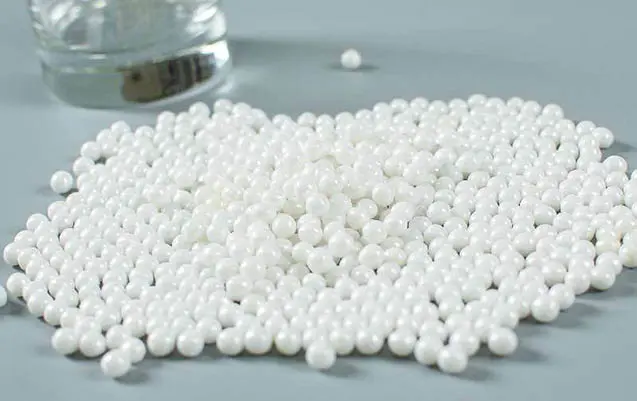
| Color | White | Ø2.5-3.0mm | |
| Package | 25kg/barrel | Other sizes can be customized | |
Product overview:
The percentage of zirconia in zirconium silicate is the lowest of all the types of zirconia beads offered by Inovatec. It comes with 65 percent zirconia content. The lower percentage of the zirconia makes it less expensive when compared to the others.
These media balls are made from processes like forming, titration, and high temperature electrolyte baking. These processes ensure that there are no fractures or pores in the beads. This type of media balls is best suited for a slurry that is lower in viscosity. The medium density feature of the media makes it suitable for low viscos slurry.
Inovatec offer three types of milling machines. All these milling machines support the use of the zirconium silicate beads. The 20 plus years of expertise in manufacturing of media and machines for mass finishing ensures that our customers get high quality solutions from us.
Feature
- Cost Effective
- Time Saver
- High Media Life
- High Breakage Resistance
- High Grinding Efficiency
- High Chemical Resistance
- Easy to Clean & Store
- Reliable Media
- Environment Friendly Media
- Corrosion Resistant
Applications
- Inks & Paints
- Pigments & Dye
- Agrochemical Industry
- Electronics Sector
- Ceramic Materials
- Pharma Sector
- Metallic Materials
- Battery
- Cosmetic Sector
Related Products


Where zirconium silicate beads fit in the zirconia range
Zirconium silicate (ZS) beads contain 65% ZrO₂ — the second-lowest zirconia content in the Inovatec range, giving them a medium density of 4.0 g/cm³. This places them between the high-performance yttria and ceria stabilized grades (6.0+ g/cm³) and the budget ZTA composite grade (3.2 g/cm³). Their specific advantage is the combination of reasonable density, moderate wear rate and lower unit cost relative to high-zirconia grades.
| Grade | ZrO₂% | Density | Wear rate | Primary use | Cost |
|---|---|---|---|---|---|
| YSZ | 95% | 6.05 g/cm³ | 0.01 kg/h/t | Pharma, battery, nano grinding | Highest |
| CSZ | ~80% | 6.20 g/cm³ | 0.01 kg/h/t | Electronics, high-speed mills | High |
| ZS (this page) | 65% | 4.0 g/cm³ | 0.03 kg/h/t | Paints, inks, pigments, agrochemicals, general dispersion | Medium |
| ZTA | 10% | 3.2 g/cm³ | 0.08 kg/h/t | Paper mill, ore grinding, mining | Lowest |
Why ZS beads suit low-viscosity slurry processes
The current page FAQ says ZS is “best for low-viscosity slurry” — here is the technical reason. In a bead mill, grinding efficiency depends on the kinetic energy delivered by each bead impact. At lower slurry viscosity, the medium resists bead motion less, which means lower-density beads can still move freely and deliver effective impacts. High-viscosity slurries require high-density beads (YSZ, CSZ) to generate enough penetration force through the thick medium.
ZS at 4.0 g/cm³ generates adequate grinding energy for low-to-medium viscosity applications such as ink and paint pigment dispersion, where the slurry is fluid enough for ZS beads to move effectively at standard mill speeds. For high-viscosity battery slurries or dense ceramic suspensions, the higher-density YSZ or CSZ grades are more appropriate.
ZS bead size selection by target particle size
| ZS bead size | Achievable D50 | Mill type | Typical application |
|---|---|---|---|
| 0.6–1.0 mm | 1–5 µm | Horizontal bead mill | Inks, coatings, organic pigments, dyes |
| 1.0–1.8 mm | 5–15 µm | Horizontal or vertical mill | Paints, agrochemicals (pesticide dispersion), food ingredients |
| 1.8–3.0 mm | 10–30 µm | Stirred mill, attrition mill | Ceramic slurry pre-grinding, cosmetic raw materials |
Primary applications by industry
| Industry | Application | Why ZS suits it |
|---|---|---|
| Inks & paints | Pigment dispersion, grinding of organic/inorganic pigments | Low-viscosity ink vehicles; medium density adequate; low SiO₂ contamination impact in non-critical colour applications |
| Coatings | Industrial and decorative coating dispersion | Cost-effective for high-volume dispersion at 5–15 µm target |
| Agrochemicals | Pesticide and herbicide dispersion and milling | Active ingredient dispersion in water-based carriers; ZS widely used as industry standard in this sector |
| Electronics | Capacitor dielectric (MLCC) pre-grinding, ferrite slurry | Finer than ZTA; lower cost than YSZ for non-critical dielectric applications |
| Cosmetics | Sunscreen (TiO₂, ZnO) and pigment milling | Low wear means low bead contamination into cosmetic base; suitable where ZrO₂/SiO₂ trace is acceptable |
| Food | Food ingredient fine grinding (cocoa, spices, minerals) | Good chemical resistance; ZrO₂ and SiO₂ generally food-grade compatible; confirm with local food safety authority |
Choosing between ZS and the other grades — quick decision guide
- Choose ZS when: target D50 >1 µm; slurry viscosity is low to medium; application is paints, inks, agrochemicals, cosmetics or food; contamination from SiO₂ wear is acceptable
- Choose YSZ when: target D50 <1 µm (sub-micron/nano); pharma, battery or electronic ceramics; near-zero contamination tolerance
- Choose CSZ when: high-speed bead mill (horizontal disc mill); need maximum impact toughness alongside high density
- Choose ZTA when: paper mill, ore grinding, mining; cost is the primary driver and particle size target is >5 µm
| Not sure which zirconia grade fits your process? Share your material, target D50, mill type and slurry viscosity. We confirm whether ZS is the right fit or recommend a better-matched grade — with a free sample available for testing. |