
 English
  Español
  Français
 An alloy wheel powder coating machine is one part of a wheel refinishing system. The spray unit applies powder to the prepared wheel, the booth collects overspray, and the oven cures the coating. Selecting these three items together helps a workshop match its equipment to wheel size, batch volume, available space, and electrical supply.
Inovatec Machinery’s wheel repair catalogue includes the YH-606 electrostatic spray unit, the YH-121319P powder coating booth, and four electric oven models. These provide options for workshops planning a dedicated wheel coating area or adding powder coating to an existing repair operation.
What Does a Wheel Powder Coating System Include?
The spray gun, booth, and curing oven perform different jobs. They should be specified separately rather than assuming a powder coating machine includes every item required for production.
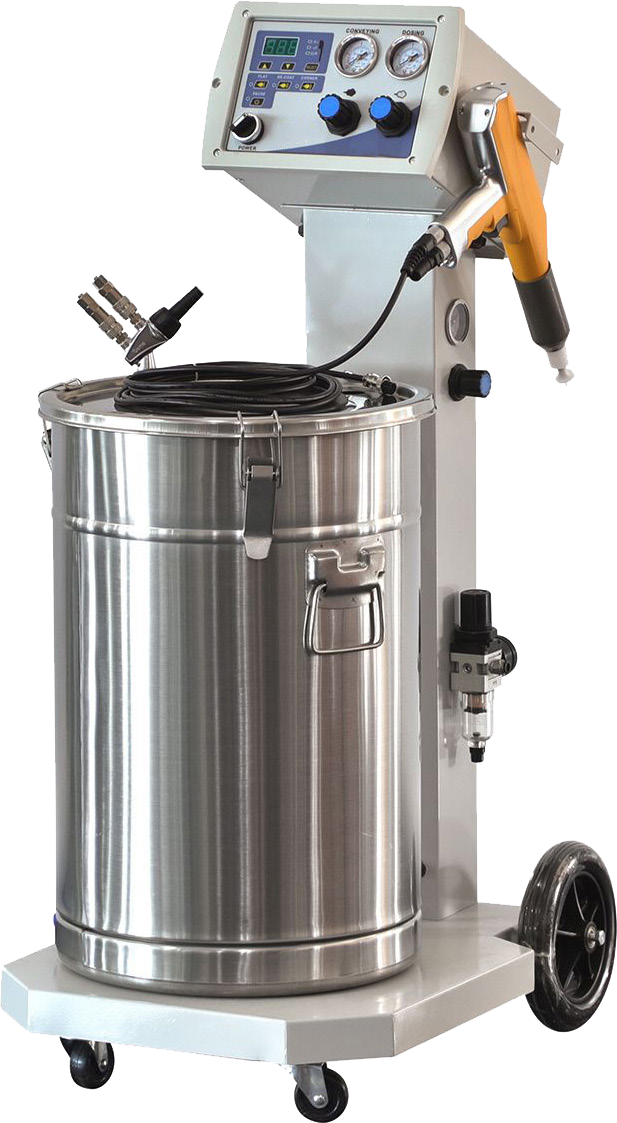
The spray unit consists of the gun, controller, powder hopper, trolley, and accessories. Compressed air carries powder through the gun, while the electrostatic system charges it for deposition on the grounded wheel.
The booth provides a defined spraying area and filters airborne overspray. Its working space must allow access to the wheel face, spokes, and barrel without forcing the operator to spray outside the intended area.
The curing oven heats the coated wheel according to the powder manufacturer’s specified schedule. Chamber size, rack arrangement, and loading method determine whether a batch fits with adequate spacing. A higher spray output alone does not increase production if the oven cannot handle the workload.
YH-606 Electrostatic Powder Coating Machine
The YH-606 is a manual electrostatic spray unit supplied with a controller, spray gun, trolley, stainless-steel hopper, and accessories. The catalogue also specifies multiple nozzles, allowing the operator to change the spray pattern for different wheel surfaces.
| Specification | Catalogue value |
|---|---|
| Electrostatic output voltage | Adjustable, 0–100 kV |
| Maximum powder injection rate | 600 g/min |
| Controller power | ≤50 W |
| Supply frequency | 50/60 Hz |
| Input voltage | 100–240 V; configuration to be confirmed when ordering |
These figures describe equipment capability, not a guaranteed coating rate or finished-wheel output. The 600 g/min value is the maximum powder feed rate, not the amount deposited on a wheel. Actual settings depend on the powder, wheel geometry, application technique, and required film thickness.
For a wheel with closely spaced spokes, check coverage in recessed areas as well as on the visible face. Increasing voltage or powder flow is not a substitute for inspecting the finished coating.
YH-121319P Powder Coating Booth for Wheels
The YH-121319P booth has a catalogue working area of W1100 × D800 × H1700 mm and an overall size of W1200 × D1300 × H1900 mm. Listed electrical power is 1.5 kW.
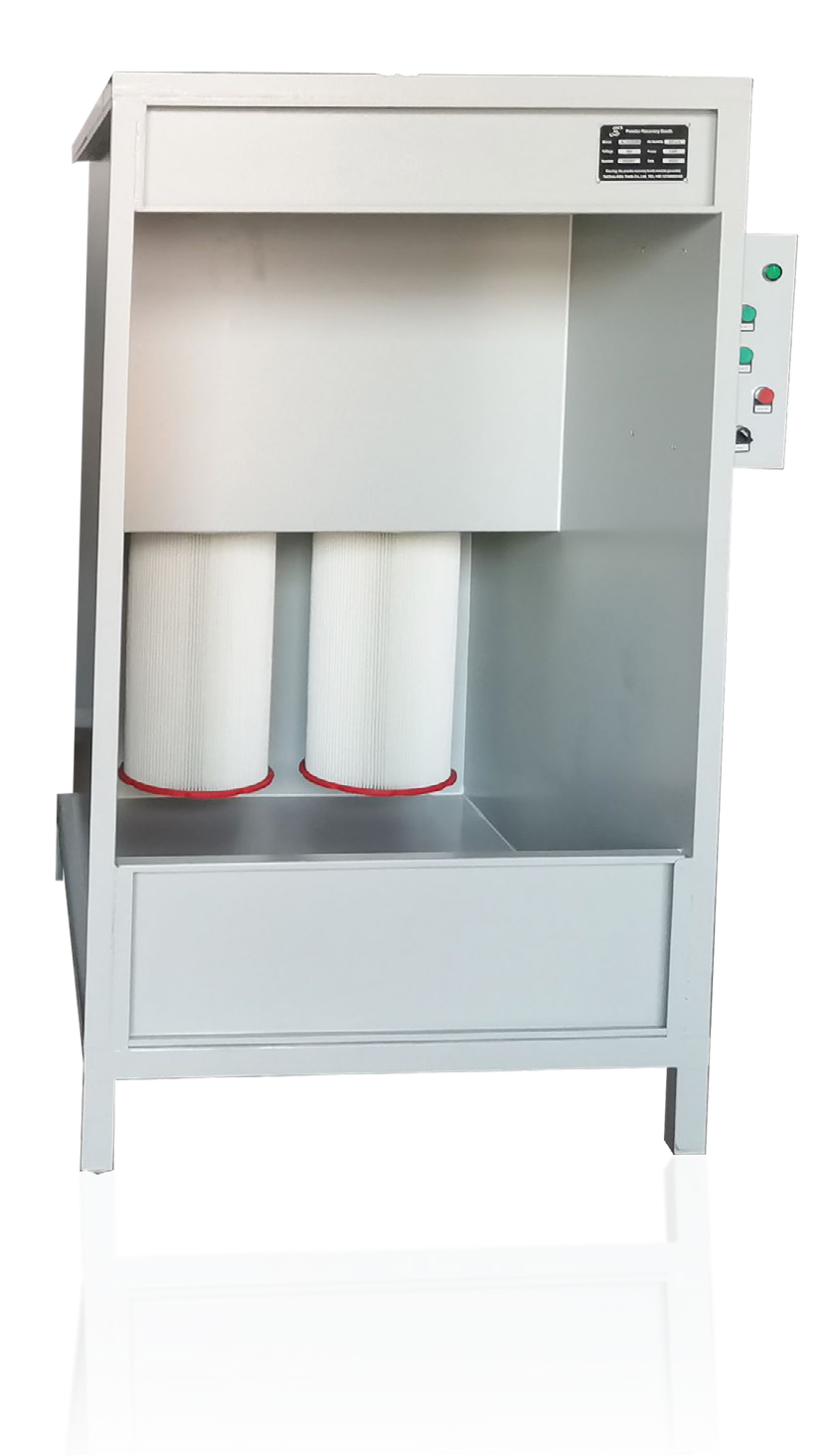
The booth uses two polyester filters with pneumatic cleaning and easy-change filter mounting. It provides a collection area for overspray and supports powder recovery. Whether recovered powder can be reused depends on cleanliness, colour separation, and the powder supplier’s instructions; collection does not mean that all powder is suitable for reuse.
Check the wheel, hanger, and required operator clearance against the working dimensions, not just the external footprint. The catalogue lists alternative booth sizes for applications needing more space. Specify the required dimensions and electrical supply before selecting a configuration.
Choose a Curing Oven Around the Wheel and Batch
Inovatec’s powder coating ovens for wheels include compact KX models and larger KL models. Start with the largest wheel to be processed, then check the loading arrangement and the number of wheels required per batch.
| Oven model | Listed power | Catalogue chamber or capacity information |
|---|---|---|
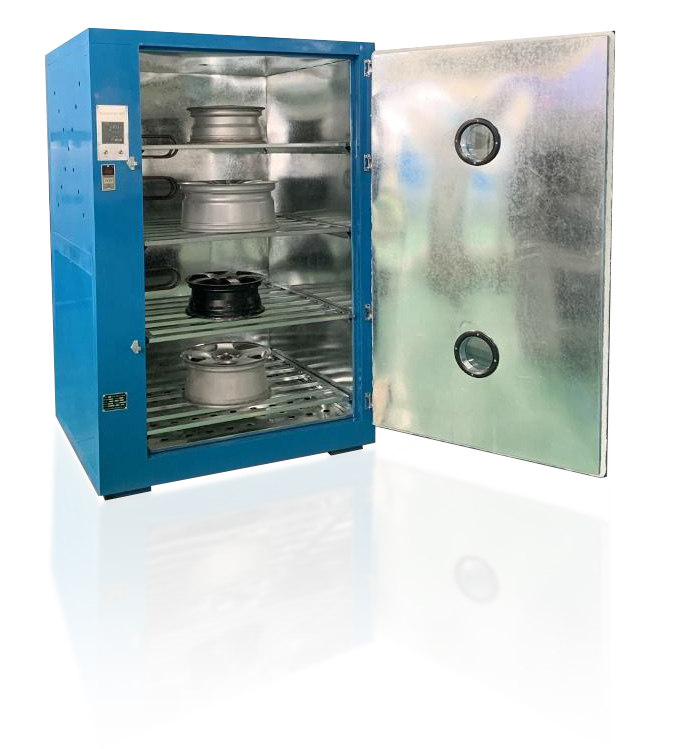
| KX-102 compact wheel oven | 4 kW | Internal dimensions: 660 × 650 × 800 mm; listed capacity: two wheels |
| KX-202 wheel curing oven | 12 kW | Internal dimensions: 1000 × 1000 × 1680 mm; four racks and a listed capacity of four wheels |
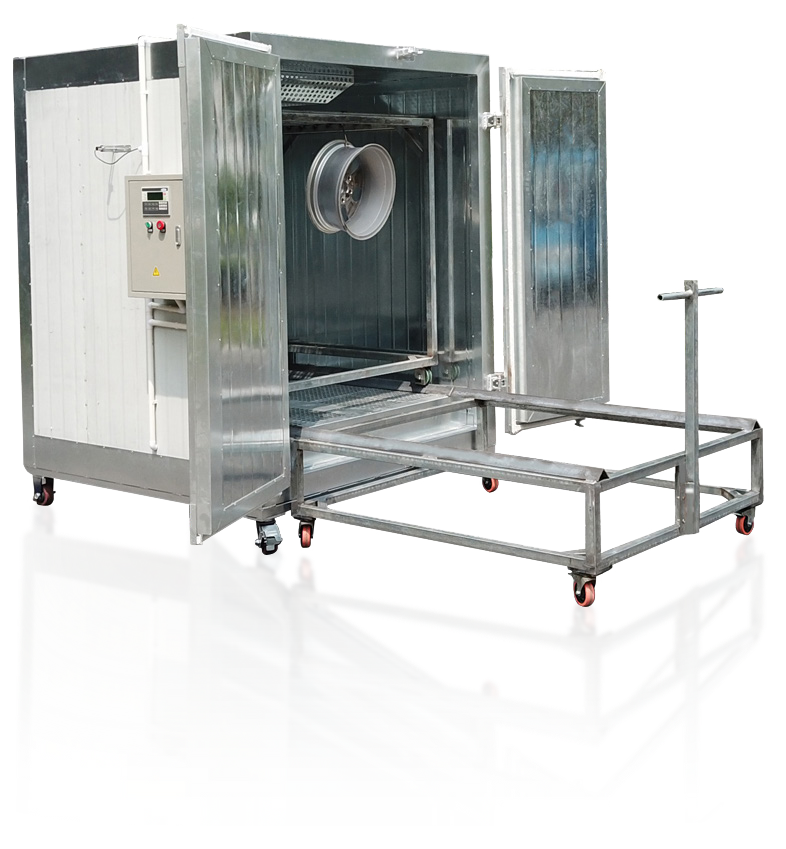
| KL-1688 wheel powder coating oven | 6 kW | Working chamber: W1000 × H1600 × D845 mm; circulation fan and hanging rails |
| KL-1864 batch wheel oven | 18 kW | Working chamber: W1600 × H1800 × D1400 mm; PLC controls, circulation fan, and trolley loading |
The KX chamber dimensions above follow the catalogue’s listed sequence; confirm the dimension orientation on the final drawing. The stated two-wheel and four-wheel capacities also require confirmation against wheel diameter, width, fixture size, and spacing.
The KX-102 is a compact option for smaller batches. The KX-202 increases the listed batch capacity, while the KL-1688 provides a hanging arrangement in a taller working chamber. The KL-1864 offers a larger chamber and trolley loading for a different batch-handling requirement.
The catalogue lists temperature controls up to 300 °C for the KX ovens and a maximum temperature of 250 °C for the KL ovens. These are equipment limits, not recommended wheel-curing temperatures. Choose the actual process temperature from the coating specification and confirm that the wheel is suitable for the proposed thermal cycle.
From Wheel Preparation to a Finished Coating
Inspect and Prepare the Wheel
Inspect the wheel before coating. Refinishing does not make a structurally unsuitable wheel safe for service, and powder coating should not conceal damage requiring a separate technical assessment.
The preparation route depends on the existing finish and wheel condition. It may include coating removal, cleaning, surface preparation, and drying. Where blasting is appropriate, a sand blasting cabinet for alloy wheels provides a separate preparation stage. Select the abrasive and process for the aluminium substrate and the coating supplier’s requirements.
Before spraying, remove preparation residues and moisture, and mask areas that must remain uncoated according to the wheel specification. The spray unit cannot compensate for contamination left on the surface.
Apply Powder in the Booth
Position the prepared wheel so the operator can reach the required surfaces. Establish grounding through the wheel and its fixture, and operate the spray equipment with the booth extraction system working. Follow the equipment instructions for setup, ventilation, protective equipment, and safe operation.
Adjust the spray pattern and powder delivery for the wheel. Check the spokes, recesses, edges, and barrel rather than judging coverage only from the front face. Keep different powders separated during collection and colour changes.
Cure, Cool, and Inspect
Transfer the coated wheel to the oven without disturbing the uncured powder. Follow the technical data sheet for the specific powder. Where the schedule specifies object temperature, the curing time applies at the wheel’s metal temperature—not merely when the oven air reaches its setpoint.
A catalogue warm-up time is therefore not a complete batch-cycle time. Loading, heating the wheel, the specified curing period, unloading, and cooling all affect workshop output. After cooling, inspect coverage and appearance, and verify film thickness and other acceptance requirements defined for the job.
What to Confirm Before Ordering
Provide the maximum wheel diameter and width, including the space needed for fixtures. Confirm whether the workshop needs single-wheel handling or batches, and estimate daily demand rather than assuming an oven’s listed capacity equals hourly production.
Electrical supply is another selection point. The catalogue lists different voltage configurations across the range, including 220 V single-phase and 380 V three-phase options for the KX-102, and 380 V three-phase for the KX-202. Confirm the exact voltage, phase, frequency, and connection requirements for each ordered machine.
Plan for customer-supplied powder, compressed air, suitable fixtures, and site utilities. Allow space for preparation, spraying, oven access, cooling, and filter servicing. Keep these requirements in the equipment specification so the spray unit, booth, oven, and workshop services form a workable process.
Routine Cleaning and Colour Changes
Powder remaining in the hopper, delivery path, nozzles, or recovery area can affect the next colour. Follow the manufacturer’s cleaning procedure before changing materials, and inspect filters and grounding contacts as part of routine equipment care.
The booth’s pneumatic filter cleaning does not eliminate filter inspection or replacement. Consider maintenance access and consumable availability alongside chamber size and electrical power when comparing a system.
Frequently Asked Questions
Does the YH-606 include a curing oven?
The catalogue lists the YH-606 as a spray unit with its controller, manual gun, trolley, hopper, and accessories. Booths and ovens are separate catalogue products. Confirm the complete supply list in the quotation.
Can the same oven process every alloy wheel size?
No. Wheel diameter, width, rack layout, and loading clearance must fit the chamber. A listed wheel count does not confirm compatibility with every wheel size.
Is there one curing temperature for all wheel powders?
No. Use the selected powder’s technical data sheet and verify compatibility with the wheel and any other coating layers. The oven’s maximum temperature is not a universal curing setting.
Specify Your Alloy Wheel Powder Coating System
To discuss a suitable equipment combination, contact Inovatec Machinery with your largest wheel dimensions, required batch size, expected daily volume, powder colours, available electrical supply, and workshop layout. These details provide a basis for checking the spray unit, booth dimensions, oven capacity, and scope of supply before you order.