 English
  Español
  Français
 Choosing a mass finishing system is not only about “barrel vs vibratory.” The right choice depends on your finishing goal, part geometry, surface risk, and how you plan to run production (manual vs automated). Use the guide below to select a system quickly, then validate with a short sample run.
1. Quick Answer (30-Second Selection): 5-Step Flow
Goal: Deburr / Round edges / Smooth (Ra) / Burnish / Remove rust
Material:
Soft metals → Plastic or fine ceramic
Hard metals → Ceramic, then Steel to shine
Plastics → Very mild media
Geometry: Measure smallest holes/slots → media much bigger (won’t enter) or much smaller (passes through). Replace worn media.
Choose system:
Barrel = gentle, low cost
Vibratory = production, easy automation
Disc = faster cutting (batch)
Centrifugal barrel = fastest, premium
Trial: Ratio 3:1–5:1, test 30–60 min, then adjust: media → size → time → compound
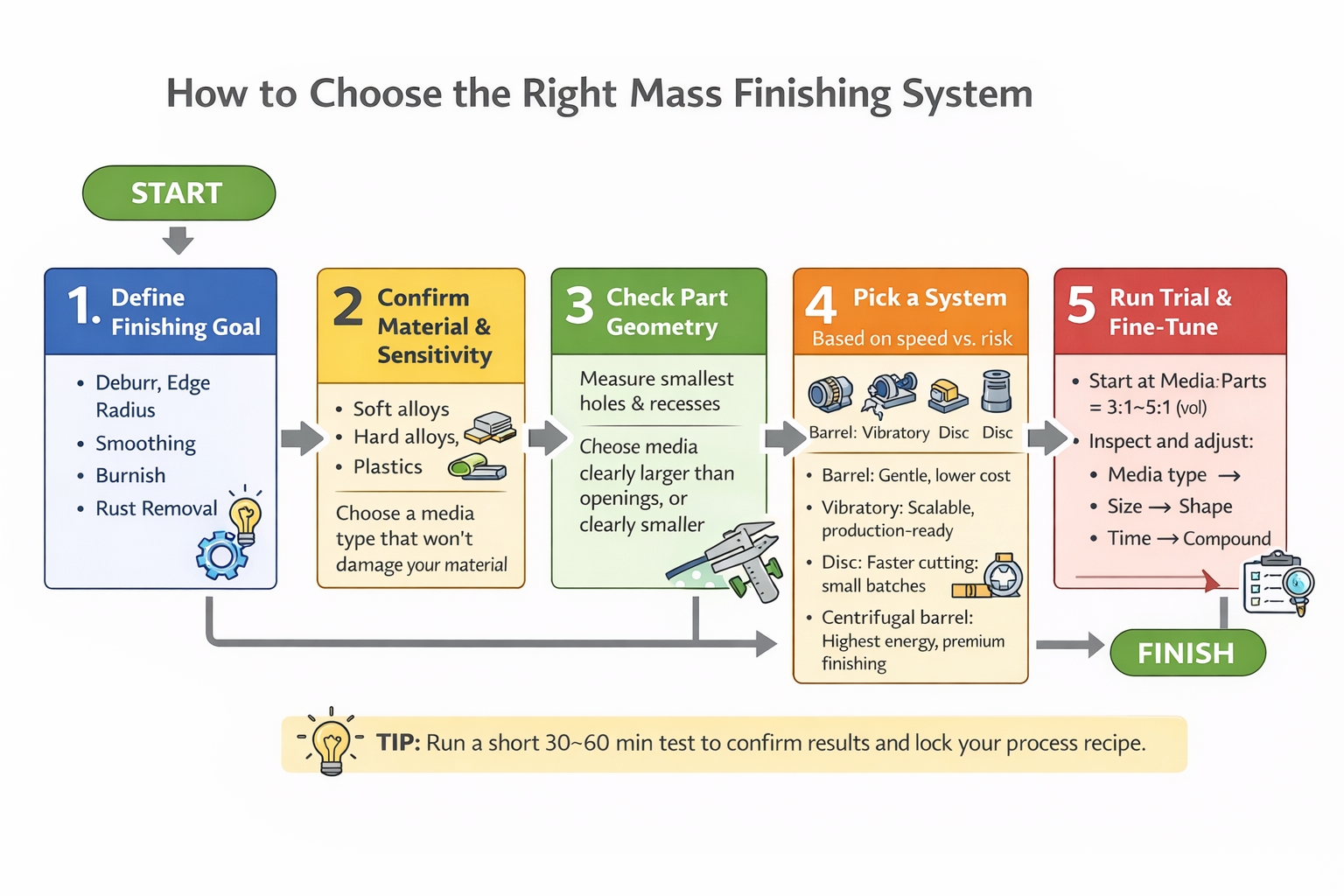 5 steps Choose the Right Mass Finishing System
2. Mass Finishing System Selection Matrix (Core Comparison Table)
| System | Typical action | Best for | Typical results | Watch-outs / Notes |
|---|---|---|---|---|
| Barrel Tumbling | Slow tumbling / cascading | Gentle finishing, low cost, larger batches | Good edge rounding; stable for delicate parts | Longer cycle time; less effective in deep recesses |
| Vibratory Finishing | High-frequency rubbing + circulation | High throughput deburring/smoothing, production consistency | Faster than barrel; repeatable surface results | Noise control, separation, and water management matter |
| Centrifugal Disc Finishing | High energy via rotating disc | Fast deburring/radiusing, small parts, time-critical work | Much faster material removal than vibratory | Batch-only; higher energy may increase part-to-part contact risk |
| Centrifugal Barrel Finishing | Highest energy in closed barrels | Premium parts, shortest cycles, high-end finishing | Excellent finish in short time; strong cutting capability | Loading control is critical; not ideal for fragile thin-wall parts |
3. Choose by Goal (Deburr / Radius / Smoothing / Burnish / Rust Removal)
| Goal | Recommended system | Why | Typical media path |
|---|---|---|---|
| Light deburring / edge conditioning | Vibratory or barrel | Gentle, scalable, low risk | Plastic or fine ceramic → optional porcelain |
| Medium/heavy deburring | Centrifugal disc / centrifugal barrel | Higher energy removes burrs faster | Ceramic (medium/fast cut) |
| Consistent edge radius | Vibratory (large batches) / centrifugal disc (faster) | Better control of radius & repeatability | Ceramic or plastic (shape matched to geometry) |
| Smoothing (Ra reduction) | Vibratory / centrifugal disc (when time-critical) | Stable contact improves finish | Fine ceramic / plastic → porcelain |
| High reflectivity (burnish) | Vibratory / barrel (burnishing) | Non-abrasive compression for shine | Steel media (balls/pins) + burnishing compound |
| Rust removal / heavy cleaning | Vibratory / disc (depending on severity) | Ceramic cuts oxidation efficiently | Ceramic + cleaning compound |
4. Choose by Part Risk (Impingement, Lodging, Thin Wall, Precision)
Different systems have different risk profiles. Use this section to avoid common production failures.
A) Impingement / part-to-part damage (dings, nicks, edge roll)
Higher risk: high-energy systems (centrifugal disc / barrel), especially with poor loading.
Reduce risk by:
Increasing media volume (parts should “float” in media, not crash together)
Using gentler media (plastic or fine ceramic) for soft alloys
Shortening cycles and adding a second smoothing stage
Using separation and rinsing to prevent re-cutting with dirty media
B) Media lodging (holes, slots, recesses)
All systems can lodge media, but high circulation can push media into features more aggressively.
Rules to avoid lodging:
Choose media clearly larger or clearly smaller than the opening
Do not run near the “almost fits” zone
Track media wear and replace before it becomes a jamming size
C) Thin-wall or easily deformed parts
Prefer: barrel tumbling (gentle) or carefully tuned vibratory with mild media.
Avoid: aggressive cutting media and long cycles that can bend edges or cause peening.
D) Precision parts (tight tolerances, critical surfaces)
Prefer: controlled vibratory or centrifugal systems with short, documented cycles.
Add a smoothing/burnish stage to stabilize appearance without excessive removal.
If dimensional change is critical, measure before/after and lock the maximum allowed time.
5. Automation & Peripherals (Separation, Dosing, Drying, Wastewater)
An “automatic mass finishing system” is more than a machine. Stable production results come from a complete line:
Separation & rinsing: reliable separation prevents media loss, mixed media, and rework
Compound dosing: consistent chemistry improves finish repeatability and reduces rejects
Drying: hot air vibratory dryers or centrifugal dryers prevent water spots and corrosion
Wastewater / filtration: keeps slurry and fines under control, reduces maintenance, and improves shop cleanliness
FAQ For Mass Finishing System Selection
1) Which system is the fastest for deburring?
Centrifugal disc and centrifugal barrel systems usually remove burrs faster due to higher energy.
2) Which system is best for delicate parts?
Barrel tumbling is typically the gentlest. Vibratory can also work well with mild media and correct loading.
3) How do I avoid media lodging in holes and slots?
Follow the anti-lodging rule: media clearly larger than the opening (won’t enter) or clearly smaller (passes through). Replace worn media before it reaches a jamming size.
4) Do I always need two stages (cut + finish)?
For cosmetic parts or Ra targets, a second smoothing/burnish stage often improves consistency and reduces rework.
5) What should I test first if results are not stable?
Adjust in order: media type → size → shape → time → compound. Also check separation/rinsing and dosing stability.
6) Can I finish mixed parts together?
It’s possible, but risk increases. Mixed sizes and shapes often lead to uneven finishing and more part-to-part contact.
Related Resource: