 English
 Español
 Français

1. What is Tumbling Media?
Most tumbling media are made in hard, molded shapes with a bonding agent that holds abrasive particles.
During processing, the media rubs against the parts. As the bond slowly wears, fresh abrasive particles are exposed, keeping the cutting action consistent.
No matter the type, tumbling media generally:
cushion parts to reduce impact damage
keep parts separated to prevent scratching
provide abrasion for deburring and smoothing
improve the tumbling motion for more even results
carry the compound and help it work effectively
3-Step Media Selection Cheat Sheet
| Step | Question | Quick Answer |
|---|---|---|
| 1 | What is your finishing goal? | Deburring/edge break → ceramic (hard metals) or plastic (soft metals). High shine → steel/porcelain. Cleaning only → mild ceramic/plastic + compound |
| 2 | What is the part material? | Steel/Stainless/Hard alloys → ceramic/steel. Aluminum/Brass/Zinc die-cast → plastic/porcelain. Plastics/wood → lightweight dry media (e.g., walnut shell/corn cob) |
| 3 | Are there holes/slots/blind features? | Yes → follow the anti-lodging rules below and favor shapes less likely to wedge (cones/triangles) |
2. The 9 Benefits of Tumbling Media
- Protect parts to avoid impingements
- Keeps parts separate from one another
- Improves tumbling performance
- Offer Abrasive Element Constantly
- Cleaning, Polishing, Burnishing
- Improve parts surface conditions
- Parts deburring and edge rounding
- Works on cavities, slots, and recesses
- Compound Carrier
3. Considerable Factors for the Selection of Tumbling Media
Some factors that are important and to be considered for selecting tumbling media include the following:
- Choosing the right media type
- Select the proper media size and shape
- Select the media with suitable abrasives
3.1 Choosing the Right Media Type
3.1.1 Ceramic Tumbling Media
For heavy cutting and strong and hard materials such as steel, ceramic media is best for the purpose.
Ceramic media is also the best choice if small media is required. Moreover, it is also feasible for the deburring of hard burrs.
It can also support hard and heavy plastic parts in a way much better than plastic tumbling media.
This media is available from a light cut to a heavy cut with a large volume of abrasive material for the fast deburring process.

3.1.2 Porcelain Tumbling Media
Another type of ceramic media is porcelain media.
It is generally available in white color and three common shapes of cylindrical, triangular, and spherical.
The main function of porcelain is to polish the metallic surface and giving a glazed look.

This process is generally completed in two steps. After the product manufacturing, the machining process leaves the marks and burrs on it.
This can be cleared with ceramic or plastic media. After that, porcelain is used to polish the surface.
For soft metals such as aluminum, sphere shape media is the best choice. Cylindrical-shaped pins work well for harder materials, for example, steel.
3.1.3. Plastic Tumbling Media
Plastic tumbling media is used for softer metals such as brass or aluminum. It gives a very smooth finish but produces a matte look with a little shine.
Plastic media is 30% lighter weight than ceramic media, so it gives less damage. Plastic media does not discolor the metal and peen over the burrs. This type of media tumbling has good performance for parts of pre-plating treatment.

3.1.4 Steel Tumbling Media
Steel tumbling media is available in various sizes and shapes.
The typical size is the ball, ball cone, diagonal, and oval ball.
Because of extremely high density, steel media imposes compressive stress on the metal surface, making parts surface work-hardened.

Besides, steel tumbling media is non-abrasive media, so it lasts a very long time. The ball burnishing process is associated with steel tumbling media. This process not only leaves a shinier surface but also reduces porosity on metal parts.
3.1.5 Comparison of different types of tumbling media with the functions
| Desired Effect | Degree of Effect / Notes | Media Recommend |
|---|---|---|
| Deburring | Light burrs / edge conditioning (minimal metal removal) | Plastic (mild cut) or fine ceramic |
| Deburring | Medium to heavy burrs / faster metal removal | Ceramic (medium/fast cut); consider larger size for faster action |
| Radiusing (Edge Rounding) | Light to heavy depending on time & aggressiveness | Ceramic or plastic (triangles, cones, pyramids, stars) |
| Radiusing (Complex / Irregular surfaces) | Better coverage on pockets, grooves, uneven surfaces | Random-shaped media (cones, pyramids, angle-cut cylinders) |
| Surface roughness (Ra reduction) | Reduce to a lower value / smoothing | Fine ceramic or plastic (fine cut) |
| Pre-plate quality (soft alloys) | Good cosmetic finish before plating; avoid discoloration | Plastic (preferred) or fine ceramic |
| Surface reflectivity | Brighten/highlight (hard alloys) | Ceramic pre-finish + steel burnishing (non-abrasive) |
| Surface reflectivity | Best quality (soft alloys) | Plastic (gentle) or porcelain (non-abrasive smoothing) |
| Surface reflectivity | Best quality (plastics) | Wood / organic media (corn cob, walnut shell) |
| Clean surfaces | Remove oil/oxidation/compound residues | Steel (burnishing/cleaning) or ceramic + suitable compound |
| Least operating cost | Varies by finish requirement & cycle time | Steel, ceramic, plastic, or wood (choose based on target result) |
| Fastest processing speed | Depends on machine energy + media + compound | Optimize the full process (media + machine + compound), not media alone |
5-Step Media Selection Flow (Quick Decision Guide)
 5 Step Media Selection Flow Quick Decision Guide
Practical note: For the same media, higher-energy machines cut faster than standard tumbling. Always validate with a short sample run before scaling production.
3.2 Media Shape and Size
3.2.1 Tumbling Media Shape
Tumbling media manufacturers can make almost all media shapes. But what media to choose must take into account parts size and shape. The feasible sizes will not lodge in the recesses or holes and the shapes must be such that they can get access to all the surfaces.

Media should not lodge into parts holes or recesses. To avoid lodging and to reach into an area pyramid, angle stars and cones are best, while angle cut cylinders are most effective for passing through holes. Measure the holes or cavities and choose a larger media that won’t fit into space or a smaller media that go through holes freely.
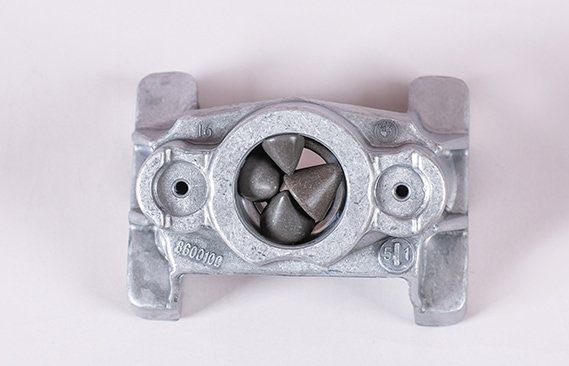
You must consider that media constantly reduce its size. When the size goes smaller, it may jam in the parts. So we need to make maximum use of the tumbling media before replacement.
Media should be able to contact all parts surface. Angle cut triangle media can reach the edge while angle cut cylinder media cannot.

You can easily collect parts from the media. The media and parts size shall have a big difference in size to be separated with a sieve. If the parts are iron material, then they can be effectively collected with a magnetic separator.
3.2.2 Tumbling Media Size
Large tumbling media will provide a rapid cut and finishing, while smaller media will provide results slower. On the other hand, large tumbling media creates a rough finishing on metals, while smaller media gives a refined surface.
For delicate products, use small tumbling media. Large-sized tumbling media can be used for hard materials as it may damage the fragile products if used with them. If small size media cut too slowly, we can consider adding 1/3 of big size media.
| Goal | Rule (Quick Formula) | What It Means | Example (Hole Ø = 6 mm) |
|---|---|---|---|
| Let media pass through a hole (cleaning inside holes) | Media max dimension ≤ Hole Ø × 1/3 | Media is small enough to flow through without frequent bridging | Max media size ≤ 2 mm |
| Pass through more easily (intentional flow) | Media max dimension ≤ Hole Ø × 1/2 | Larger but still likely to pass; faster circulation, slightly higher bridging risk | Max media size ≤ 3 mm |
| Prevent lodging / jamming (anti-stuck) | Media max dimension ≥ Hole Ø × 1.5 | Media is too large to enter the hole and wedge | Min media size ≥ 9 mm |
| Safest “never lodge” approach | Media max dimension ≥ Hole Ø × 2 | Maximum safety margin against lodging in holes/slots | Min media size ≥ 12 mm |
Note: “Media max dimension” means the largest outside measurement of the media shape (e.g., cone base diameter, triangle edge length, cylinder diameter).
3.3 Aggressiveness of Media
The requirement for the aggressiveness of the media depends upon the need for a fine vs. coarse cut. Tumbling media aggressiveness can be adjusted by abrasive types, abrasive content, and abrasive mesh grit.
3.3.1 Abrasive types
There are quite a lot of abrasive types available to include in the tumbling media. For example, brown corundum, white corundum, silicon carbide, silica, chromium oxide, etc. Among them, silicon carbide is the most aggressive abrasive type known to all. Silica is typically used in plastic media, while corundum is commonly used in ceramic media.
3.3.2 Abrasive content
In ceramic deburring media, the specific abrasive content is 20% of the weight.
The most popular Rosler RS media have abrasive content around 20%, while for Walther Trowal WXC ceramic deburring media, the abrasive content is 50-60%.
Some types of tumbling media, for example, fine porcelain media, have no abrasive content. In a word, we can increase the media abrasiveness with abrasive content.
3.3.3 Abrasive mesh size
U.S. Mesh Size is defined as the number of openings in one square inch of a screen.
We use the term mesh size to quantify the abrasive grit size. The bigger the Mesh size, the finer grade of the abrasive.
For example, 120# mesh corundum abrasive is courser than 320# mesh corundum abrasive. So 120# mesh corundum has more aggressive cutting power.
Application Example 1: Die Casting Aluminum Parts (Deburr + Brighten)
| Stage | Goal | Recommended Media | Compound / Mode | Typical Time | Notes |
|---|---|---|---|---|---|
| 1 | Light deburring / remove sharp edges | Plastic cones (10–15 mm) or mild-cut ceramic triangles (small size) | Wet + neutral deburring compound | 45–120 min | Plastic is safer for aluminum; choose size to avoid lodging in holes |
| 2 | Brighten / smooth appearance | Porcelain cylinders/pins (non-abrasive) | Wet + burnishing compound | 30–60 min | Reduces part-to-part contact marks |
| QC | Check burr & edge radius | — | — | — | Inspect edges, holes, and cosmetic surfaces for dings or media jamming |
Application Example 2: Stainless Steel CNC Parts (Deburr + Burnish)
| Stage | Goal | Recommended Media | Compound / Mode | Typical Time | Notes |
|---|---|---|---|---|---|
| 1 | Medium-to-heavy deburring / faster metal removal | Ceramic triangles (medium/fast cut, 10–15 mm class) | Wet + deburring compound | 60–180 min | Larger ceramic cuts faster; keep enough media volume to reduce part-to-part contact |
| 2 | Smoothing / lower Ra | Fine ceramic or porcelain media | Wet + polishing compound | 30–90 min | Improves consistency before burnishing |
| 3 | High reflectivity / burnishing | Steel balls/pins (non-abrasive) | Wet + burnishing compound | 20–60 min | Do not mix cutting ceramic and steel in the same stage |
Application Example 3: Brass Stamping Parts (Pre-Plate Preparation)
| Stage | Goal | Recommended Media | Compound / Mode | Typical Time | Notes |
|---|---|---|---|---|---|
| 1 | Gentle deburring & smoothing (avoid discoloration) | Plastic pyramids/cones (mild cut, 8–12 mm class) | Wet + neutral compound | 30–120 min | Plastic is common for softer metals before plating |
| 2 | Clean surfaces / remove residues | Fine ceramic or porcelain (optional) | Wet + cleaning compound | 15–45 min | Helps stabilize surface appearance and cleanliness |
| Optional | Dry polishing (cosmetic improvement) | Walnut shell / corn cob (organic media) | Dry + polishing paste | 30–120 min | Great for drying + light polish; check plating line requirements |