 English
  Español
  Français
The expectations of manufacturing industries have increased in recent years. Different mechanical processes, such as turning, milling, etc., lead to surfaces with inherent irregularities. Therefore, manufacturing industries are faced with the responsibility of finding improved finishing operations that will nullify these effects and improve other properties in these materials.
Surface plastic deformation processes resolve these impediments. This process does not involve material removal but preferably deforms the surface plastically under compressive load. The body of the component under this external load is subject to cold working.
Burnishing is one such surface plastic deformation technique. It has been in existence for a long time and has continued to gain general acceptance in the manufacturing industry today.
1. What is Burnishing?
Burnishing is a surface modification process through which smooth surface finishes are achieved.
This is possible using the planetary rotation of a tool over a board of turned surfaces.
In general, burnishing is a cold working process that smoothens, removes discoloration, and polishes a metal surface into a sparkling finish, which is nearly as good as new.
This specifically targets the peaks and valleys as contained in all machine or other processed metal surfaces.
Apply with the burnishing tool with a calculated amount of force.
This force drives the materials which hitherto were on the peak to flow into the valleys.
This effect brought about will be a reduction in the height of the peak and the depth of the valley.

The schematic working principle of burnishing process (Photo Courtesy Reseachgate)
This method was first developed in America in the 1930s.
Apply burnishing to impart comprehensive residual stress to layers of various metal parts, specifically the railroad, car axle, and machinery shafts.
Over the years, it came widely accepted and has found applications in almost every industry the world over.
2. Types of Burnishing
This process can be classified into different types depending on the kind of tool used, the geometry of the workpieces being worked on, etc.
Burnishing is further classified into two groups: Ball burnishing and Roller burnishing.
However, for this article’s purpose, we’re going to consider ball burnishing, its definition, advantages, and application in various industries and businesses in the world today.

Ball burnishing vs roller burnishing (Photo courtesy Substech)
Ball burnishing: In this type of burnishing, one or more spherical balls are supported in shank by the hydraulic pressure of a fluid, spring, or the relative force of the workpiece.
The ball is continuously kept in contact with the workpiece by a fluid circulated using a hydraulic pump.
As the tool is fed along the workpiece, the ball becomes pressed against it, resulting in a burnishing operation.
Depending on the desired effect, the force of burnishing can then be controlled by varying the fluid’s hydraulic pressure.
3. Advantages of Ball Burnishing
- This process allows parts to be produced with high control over the dimension and allowing for very accurate sizes.
- It produces a very smooth surface finish
- Saves cost and is more economical compared to the other burnishing processes
- Creates improvements in physical properties and increases the fatigue life of components
4. Benefits of Ball Burnishing with Stainless Steel Media
Stainless steel media is viral in surface finishing due to its superior characteristics.
This has led it to become the most preferred and widely accepted in industries the world over.
Below are some inherent characteristics which make the stainless steel media the most widely used today:
- Higher Surface Pressure and Longer Media Life
- Shorter Finnish Time
- Improves Pre-Plate Finishing
- Reduces Porosity on Plated Parts
- Cost-effective
| Section | Benefit | What it means in practice |
|---|---|---|
| 4.1 | Higher surface pressure & longer media life | Stainless steel media is non-consumable and very hard, so it lasts a long time, works well in vibratory/barrel processes, and generates minimal solid waste. |
| 4.2 | Shorter finishing time | Steel media is heavier than most alternatives, creating higher contact pressure and stronger rubbing action—so parts finish faster. |
| 4.3 | Improves pre-plate finishing | The weight of steel media helps flatten tiny surface irregularities, improving surface preparation and reducing plating defects. |
| 4.4 | Reduces porosity on plated parts | Compacting action helps close “pin-hole” pores in softer plated layers, improving corrosion resistance after plating. |
| 4.5 | Cost-effective | Long service life reduces replacement cost; using stainless steel shot also avoids rust inhibitors needed for plain steel media. |
5. Success stories in the Application of Stainless Steel Burnishing
Burnishing brass components has become an economical solution for repairing the nicks, scrapes, and scratches developed by manufacturing.
Businesses and companies continue to seek better ways of maximizing profit and lowering costs.
Therefore, they have turned to burnish as a means through which they can among other advantages prevent wear, improve shine, and extend the lifespan of machine parts and components.
a) brass fitting parts
The brass fitting parts before the ball burnishing surface is dull and dark.
With ball burnishing in stainless steel ball, the surface gets to shine and clean.
This product is ready to deliver to the market.
b) Steel bearing parts
Another example is the steel bearing parts.
Ball burnishing process not only brightens parts surface but also cleans the dirt and removes the oily substance.
You could clearly compare the parts before and after processing.

Iron-bearing parts before and after ball burnishing
c) Brass stamping parts
The left parts below are brass parts before ball burnishing, and the right part is after ball burnishing.
Flattened the burr at the punching hole after the tumbling process.
remove the dirt and oxidation layer.
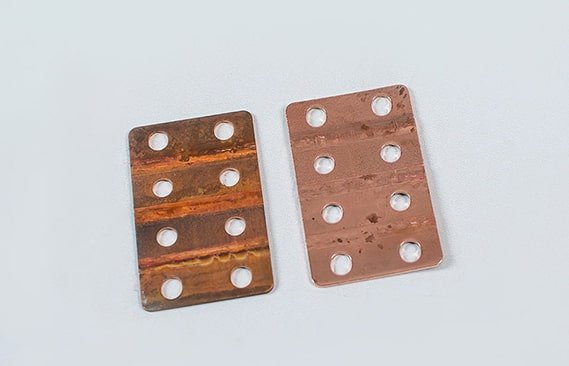
Brass punched parts before and after polishing
Here are some results of the application of stainless steel burnishing processes
- Commercial burnishing systems have proved useful in extending the lifespan of tableware in restaurant businesses
- Restored beauty and shine in parts and components used in automotive industries
- Improvement in parts used in aeronautic industries
- Repair and restore flatware and hollowware
- Repair and restore metal serving dishes and a host of other applications
Conclusion
This article discussed the concept of burnishing and two types of burnishing techniques, including ball burnishing and roller burnishing.
In mass finishing, we focus on ball burnishing and its advantages.
The most commonly used media in the ball burnishing process is stainless steel tumbling media
Later, we list 5 benefits of the process. Last, we give an example of how the ball burnishing process improves metal parts surface conditions.
If you have any questions or need any help with parts surface finishing, please feel free to contact us or just send an email.