 English
 Español
 Français

Electroplating quality is decided long before parts enter the plating bath.
If the surface still holds oil, oxides, dust, or microscopic burrs, you’ll often see problems like poor adhesion, pinholes, rough deposits, “orange peel,” and uneven thickness. That’s why many factories now use vibratory finishing as a standardized pre-plating step—especially for die-cast and machined parts—because it’s consistent, scalable, and dramatically reduces manual labor.
Below is a practical guide to why pre-plating vibratory finishing works, plus hands-on setup tips and real process examples.

Electroplating workshop
1. Why Vibratory Finishing Works for Pre-Plating
A typical vibratory finishing line can handle three critical tasks before electroplating:
1.1 Remove oil, dirt, rust, and residues (fast, fully covered cleaning)
During machining, stamping, or die casting, parts often carry:
cutting oil / grease
oxides / light rust
dust and embedded debris
These contaminants block effective contact between the metal surface and plating solution, making the electroplating reaction unstable or incomplete.
With a vibratory finisher, parts tumble with media while a mild alkaline compound circulates through the load, allowing the media to scrub not only the outer surfaces but also cavities, slots, and contours. The debris is flushed away continuously—saving time and lowering cost per part.
1.2 Improve surface condition for more uniform plating
The rougher the surface, the harder it is to control current density across the part.
High roughness increases true surface area and causes current distribution to vary between peaks and valleys. The result can be:
uneven coating thickness
defects in corners/concave zones
inconsistent appearance
Pre-plating vibratory finishing smooths the surface (unless your spec requires intentional roughness), helping plating build more uniformly and predictably.
1.3 Dry correctly to prevent oxidation and water stains (especially for Zn/Zamak)
Most pre-plating processes are water-based, so drying and rust prevention are not optional.
Centrifugal spin drying with hot air is common and efficient for small parts—but in some applications (especially zinc/Zamak), parts can form an oxidation layer or retain water in slots.
When parts tend to trap water, a corn cob vibratory dryer can remove moisture quickly and gently once heated, reducing water residue without sticking to parts.
2. Practical Tips to Improve Plating Quality (Pre-Plating Setup Checklist)
Some surface defects only become visible after plating (classic example: “orange peel”). To avoid finishing an entire batch only to discover hidden imperfections later, use this quick checklist:
Quick inspection trick
If parts have a matte finish from plastic/polyester media, you can rub a small area with a pencil eraser to reveal hidden defects before plating.
Process tuning tips (the ones that actually move the needle)
Media hardness: choose softer media when surface damage is a risk; polyester plastic media is commonly used for pre-plating.
Media size: smaller media cushions parts better and reduces impact marks.
Avoid part-on-part damage: don’t overload; too many parts increase collision and surface dings.
Water/compound level: more water + proper compound improves cushioning and stabilizes motion.
Vibration aggressiveness: if the machine runs too hard, parts will hit—use VFD control to slow the action.
Add an extra step when needed: if surface condition isn’t stable enough, add a second vibratory stage for better leveling.
3. Case Studies (Real-World Pre-Plating Results)
Case A: AL6061 machined parts (fast smoothing + slot deburring)
Goal: remove machining marks and prepare for plating
Media choice: general-cut plastic media; tetrahedron shape for slots/cavities (good access, less lodging risk)
Cycle time: ~30 minutes
Result: surface is smooth and ready for electroplating, at a fraction of manual buffing time
Case B: Zamak3 die-cast parts (two-step smoothing, optional final polish)
A common robust route:
Ceramic media to remove die-casting defects (typically 3–4 hours, depending on surface quality)
Plastic media to reduce roughness (typically 2–3 hours)
Optional: zirconia balls for higher gloss / finer surface
This staged approach helps move from “casting surface” → “plating-ready” with controlled, repeatable results.
Note on tooling quality: if the mold condition is poor and leaves heavy parting lines, some manual removal may still be required. In that case, improving mold quality is usually the best long-term cost reducer.
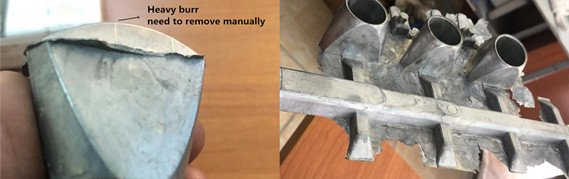
Zamak parts before deburring
4. Summary
Pre-plating vibratory finishing improves electroplating results mainly by:
removing grease and dirt,
improving surface condition for uniform coating,
drying effectively to prevent oxidation and water residue.
If you combine the right media selection, correct water/compound control, and stable vibration intensity, you’ll see fewer plating defects and more consistent appearance batch-to-batch.
Related readings:
- Vibratory Finishing Process Guide for Beginner
- The Vibratory Finishing 101: A Layman’s Guide
- Tumbling Media Selection Guide
- Aggressiveness of Tumbling Media Explained
- Shapes of Tumbling Media Explained
- Avoiding Tumbling Media Lodging Issues
- Zamak3 Deburring Furniture Hinges
- X Project – Zinc Polish Zamak3 Faucet