
 English
  Español
  Français
After fabrication, probably you would like to improve surface appearance, and durability or add special treatment.
Well, all you need is the best metal finishing for fabricated parts. The best part, this guide takes you through the most common methods for metal finishing.
What is Metal Finishing?
The process of metal finishing is the last step in manufacturing processes associated with providing aesthetics and environmental qualities to metals.
Depending on your unique requirements, you can smoothen, roughen, coat, or change color on fabricated metal sections.
Benefits of Metal Surface Finishing
· Improve Performance Characteristics – Enhanced Resistance, and Durability
The ability to work out under various weather conditions is one of the biggest advantages of any metal finishing procedure. This will make the items remain still stronger than anticipated despite having a protective metal coating. If the metal items are not treated, their surface will degrade and wear out much faster over time.
Finished metal products have a longer life span. This finishing processing may offer corrosion durability against wear and chemical damage. This is especially important for sectors of the economy that use machinery which have to stand up for a long period.
· Enhanced Appearance
Metal finishing involves various methods such as e-coating, powder coating, anodizing, etc. But, no matter what method is used, this process will improve the overall look of the metal product. The process works to eliminate any sharp edges, clean the surface, and smooth it.
· Easy Cleaning
Lastly, metal finishing makes cleaning metal products very convenient. The surface is so incredibly smooth that it reduces adhesion and contamination. Apart from that, the finish will minimize the time spent on its cleaning. No adverse chemicals, which can intensify the wear rate of surface areas, will be needed either.
 Metal Finishing Using Sandpaper
Types of Finishing on Metal
1. Sanding Metal
Metal sanding is an operation of surface finishing in which abrasive material comes into contact with the metal surfaces and allows it to clean off dirt. This method removes rust, imperfections, and undesirable coatings effectively. It is highly useful when metal prepares itself for other finishing processes like painting or coating.
 Sanding Metal Smooth
Hand sanding could be time-consuming and laborious, particularly when dealing with large areas. Furthermore, while sanding, the operation generates dust hence proper safety procedures should be taken. The shape of the size may need to have changed due to overspending, so one needs this plan and how precise an outcome they should aim for.
2. Magnetic Polishing
Magnetic polishing is a surface finishing technique that uses magnetic fields to improve the smoothing process. When polishing metal items, the surface is put in a rotating drum filled with water and brushing material while arranging them inside. This magnetic action ensures not only constant but also contact with small details and access to recessed places that can be difficult to reach by conventional procedures.
One of the numerous benefits that magnetic polishing has is the possibility of obtaining uniform and smooth surfaces on many intricate or small metal elements. It is a safe and effective method to enhance surface quality, burr, and polish without compromising sensitive parts. It may not suit larger metal objects due to size limitations that can easily fit in the polishing drum.
3. Lapping Metal
In this process, abrasive particles are imbibed in paste or liquid. Lapping compounds are located between two surfaces that move back and forth because of forces acting across them in a reciprocatory manner. During the lap process, the metal item gets a gradual, random, light motion with the soft iron tool and mild abrasive.
The term lapping is so elemental and can refer to a great deal of different sorts of metal, such as ceramics or brass plate steel. While lap has certain advantages, there are also disadvantages in terms of time and ability to get adequately precise. It could be a long time, especially for more complicated or large pieces.
 Lapping Process on Metal
4. Ultrasonic Polishing Metal
Ultrasonic polishing utilizes an ultrasonic spindle with a very soft and precise tip. 2100- 250 strokes per second is the operation range of speed.
With the help of this technique, a polisher could give very precise finishes to minute details on any metal object. The points do not touch the metal. Instead, a pressure wave is created, which cleans the surface securely.
Ultrasonic polishing has several benefits; for instance, it is possible to achieve high precision and control while finishing. Polishing will be uniform on complex geometries and fine detail due to microscopic abrasive action. Ultrasonic polishing can also be an effective method, though it is not free from its flaws, especially with larger metal objects because of size and coverage limitations in the ultrasound bath focused on a certain area.
 Ultrasonic Polishing on a Metal
5. Tumbling Metal
In this metal finishing technique, loose abrasive media are put in a chamber together with its products. The mixture is then turned or shaken to combine everything. The process is very flexible, adjusting to different shapes and sizes of metal components.
Metal surface finishing by tumbling works extremely well for deburring, edge radius, and polishing.
Tumbling is not without its drawbacks. Such specific, highly detailed finishes may be difficult, especially for delicate or intricate parts. It can also produce heat, and adequate cooling mechanisms may be required to avoid the burning of metal parts.
 a Tumble Finish On Metal
6. Filing Metal
Metal filing is a manual finishing that involves the use of a hand tool known as a file, which has sharp teeth or ridges arranged in rows.
Copperworkers use files to form, polish, and grind by forcing hard-rubbing surfaces with the workpiece. It is particularly applicable for smaller or more complicated workpieces where high levels of detail are required.
This can be a slow process, particularly for large surfaces or when more material needs to be removed from the surface. The finish levels attained using filing processes might not be too smooth when compared to other finishing methods, such as polishing.
7. Metal Electroplating
Metal electroplating is a finishing technology applied to the surface of an element in which ultra-thin layers of metal are deposited on it through electric currents.
The substrate, which is mostly a metal object, is placed in an electrolyte solution that houses dissolved metal ions. When an electric current is passed through, metal ions are reduced to the substrate’s surface, and a thin layer of metal forms.
Metal electroplating improves corrosion resistance in addition to increased durability and the ability to achieve decorative finishes. The process grants the possibility to apply metal coatings to particular areas of an object. Some metals have their mechanical properties impacted by hydrogen embrittlement resulting from electroplating.
 Metal Electroplating Principle
8. Metal Electroless Plating
This is a self-catalytic plating that does not require any external power because it uses no electricity. Instead, the metal part plunges into copper or nickel solutions to start a process that tears apart these ions and forms chemical bonds. It adheres well to a wide range of substrates, such as plastics, ceramics, and metals, thereby making it versatile in applications.
It is not easy to control the thickness of the deposited layer, especially on complex structures. The bath composition and operating conditions should be monitored carefully to ensure the desirable plating characteristics are maintained.
 Metal Electroless Plating Deposition Principle
9. Sandblasting Metal
The process of sandblasting a metal, also called abrasive blasting, uses high-pressure streams and particles to clean, etch, or modify the surfaces of metals.
This method involves shooting materials such as sand at the metal under appropriate conditions and properly removing rust, contaminants, and old coatings. The accuracy of controlling pressure and abrasive material also makes it applicable to various types of metals.
Sandblasting provides rapid and efficient surface preparation that increases adhesion for subsequent coatings. However, there is generation of dust, potential damage to delicate metalwork, proper disposal, and alternative considerations of the environmental impact involved in operating sandblasting.
Here is a good dry sand blasting machine.
 Sandblasting Service on Metal
10. Anodizing Metals
Anodizing is a surface finishing procedure usually used for aluminum alloys. 5 It involves controlled oxidation through electrolysis to form a protective metallic oxide layer that acts as a solid shield for the workpiece. This process is very versatile, as the oxide layer can be changed to a particular use such that it may add some beautiful colors by dye.
After performing the procedure, anodized surfaces with enhanced corrosion resistance and hardness are visible. It is easily scored, has intricate color coordinating processes, and only works with aluminum and its alloy. Another factor that could influence the viability of smaller-scale operations is related to the initial investment in anodizing apparatus.
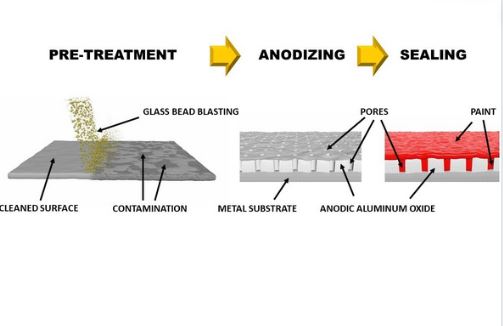 Basic Steps of Anodizing
11. Metal Grinding
Metal grinding is a material removal procedure that wears and smooths metal surfaces by using abrasive particles together with equipment such as grinding wheels or belts. The abrasive process, whether done through manual or grinding equipment, smoothens out defects.
However, one drawback is that it produces heat, which requires the installation of air conditioning units. There are also concerns about the safety of dust and other abrasive particles. The only parameter that determines the quality of completed goods is competence among operators.
 Metal Grinding
12. Buffing Metal
Buffing is a metal finishing process that leverages the use of a rotating cloth wheel or grinding pads to smooth and polish surfaces, improving their appearance. Buffing encompasses the application of buff compounds, i.e., abrasive pastes, which are rubbed against metal to remove fine scratches and imperfections.
 Metal Buffing
This is a versatile method that can be used regardless of what type of metal it uses, and you are able to control the shine that it will have.
The limitations include the possibility of heat production, especially on sensitive metals, which should also be handled very carefully to avoid overpolishing or changing the dimensions of a workpiece.
13. Painting Metal
Metal painting is the process of applying liquid coverings to surfaces for either decorative purposes or protection. On the positive side, cost-effectiveness and customization are possible with quick application. While painting enables a vast array of colors and patterns, paint may need replacement from time to time, and in addition, it can be more susceptible to damage over the years.
It is often used in many sectors because of its simplicity and cost efficiency to achieve the intended appearance on metal surfaces.
Limitations include the possibility of chipping or peeling, which can develop over time, especially in areas of high wear. Furthermore, this process might increase the weight of a metal object and also bring about environmental concerns related to paint waste.
 Painting On Metal
14. Powder Coating Metal
Alternatively, powder coating can be used in modern painting. With the help of an electrostatic charge, it sticks powder particles to metal parts.
The powder particles are evenly applied to the surface material before they undergo treatment with heat or ultraviolet rays. This process is a quick and efficient method to paint metal objects such as bicycle frames, auto parts, aluminum tile trim or general fabrications.
On the other hand, its limitations include a limited color range compared to liquid paints and uneven coating in intricate designs. Powder coating is a very popular finishing method for its durable, good-looking finishes on all kinds of metal products, from automobile parts to kitchen appliances.
15. Blasting Metal
Abrasive blasting is typically used to produce products with a consistent matte texture. It is a cheap process for integrating surface cleaning and finishing into one single operation. During the blasting process, a high-pressure abrasive flow is sprayed on to modify the texture of the metal surface by removing debris and producing a smooth finish.
Metal blasting provides effective surface preparation, allowing better adhesion for further coatings or other treatments. Blasting is flexible, suitable for all metals, and helps give surfaces a grainy feel. A careful consideration of limitations shows that substrate damage may take place when using aggressive materials, and dust can be an environmental problem while disposing of waste.
16. Galvanizing Metal
Galvanizing is a process whereby the surfaces of steel or iron are coated with a protective layer made up of zinc to prevent corrosion. Galvanizing is the production of a zinc-iron alloy coating through either a hot dip or electroplate process. It has excellent corrosion resistance and an enhanced lifespan made possible through sacrificial protection.
Galvanized metal is used for outdoor applications and in harsh environments. Its limitations include only a specific range of appearances characterized by the typical silver-gray finish and uneven coverage.
Because galvanizing is cost-saving, it provides strong protection against elements such as wind and water, making it very popular in the construction of buildings.
 The Galvanizing Process
17. Alkaline Cleaning Metal
Alkaline cleaning of metal entails using alkali solutions to remove grease, oils, and dirt from the surface. It is the utilization of water-based solutions with high pH levels that are applied to eliminate oil at high temperatures.
Alkaline cleaning is especially appropriate for pre-coating or finishing treatments that pertain to metal surfaces.
Potential limitations may include environmental concerns as a result of the disposal needs involving alkaline solutions. If the process is not properly controlled, there could be material damage risks. Alkaline cleaning is widely used in industries where there is a need for impeccable metal surfaces to ensure the best adhesion and quality of subsequent treatments.
18. Passivation
Passivation is a chemical process that improves the corrosion resistance of stainless steel by increasing the formation of an oxide layer on its surface.
Passivation processes such as the removal of free iron particles and the creation of a passive corrosion-resistant surface. This method increases longevity and enhances resistance to rust and corrosion in harsh conditions.
Passivation guarantees preserving the material’s inherent corrosion resistance properties. However, such applications have some complexity in their processes and potential environmental issues.
19. Hot Blackening
Hot blackening is a chemical process in which the surface of a metal, usually steel or iron oxide, turns into acid.
This process includes placing the metal in a heated solution that generates a dark, corrosion-proof layer. It offers better aesthetics, reduced glare, and increased wear resistance.
Hot blackening gives an attractive and uniform appearance to the surface and is often used for decorative purposes, which allows for a device with a hot-blackened cover. Its limitations include susceptibility to scratching, and the process can generate fumes requiring proper ventilation. With its distinctive black color durability and proper protection against corrosion, hot blackening is often used in firearms, automotive parts, or decorative hardware.
20. Vibratory Finishing
Vibratory finishing is a mass action procedure based on vibrational movement that serves to obtain the required surface finish for metal parts.
They include the use of vibratory bowls or tubs filled with abrasive media, together with the metal parts, to perform a finishing action.
Besides, the benefits involve even and consistent outcomes on a vast range of pieces, as well as the possibility to deburr, descale, or polish surfaces in an efficient manner.
Vibratory finishing is effective for more complicated shapes and inaccessible parts. Such limitations may include longer processing times compared to some other finishing methods. This method is used in industries like automotive, jewelry, and aerospace to obtain smooth and finished metal surfaces.
21. Brushed Metal Surface Finish
A brushed metal surface finish is based on a treatment of the surfaces of metals to produce texture and a linear appearance.
It involves the use of abrasive materials such as wire brushes or pads to inscribe parallel lines or any conceivable pattern on a metal surface. Advantages include a protective, shiny finish that hides scratches and fingerprints well.
Brushed finishes have a unique visual appearance and are commonly selected for their modern, contemporary appeal.
Challenges may include difficulty obtaining even finishes on large areas, as well as challenges involved in maintaining a brushed appearance over time. It is often used in architectural features, appliances, and consumer electronics for its attractive appearance.
Conclusion
Surface finishing is a significant aspect of the production of metal products. It is not only beneficial to end users, but it can also benefit the manufacturer if properly controlled.
More Resources:
Metal Finishing – Source: METAL SUPERMARKET
Metal Finishes – Source: THOMASNET